
SIT30821 – Certificate III in Commercial Cookery
Certificate III in Commercial Cookery
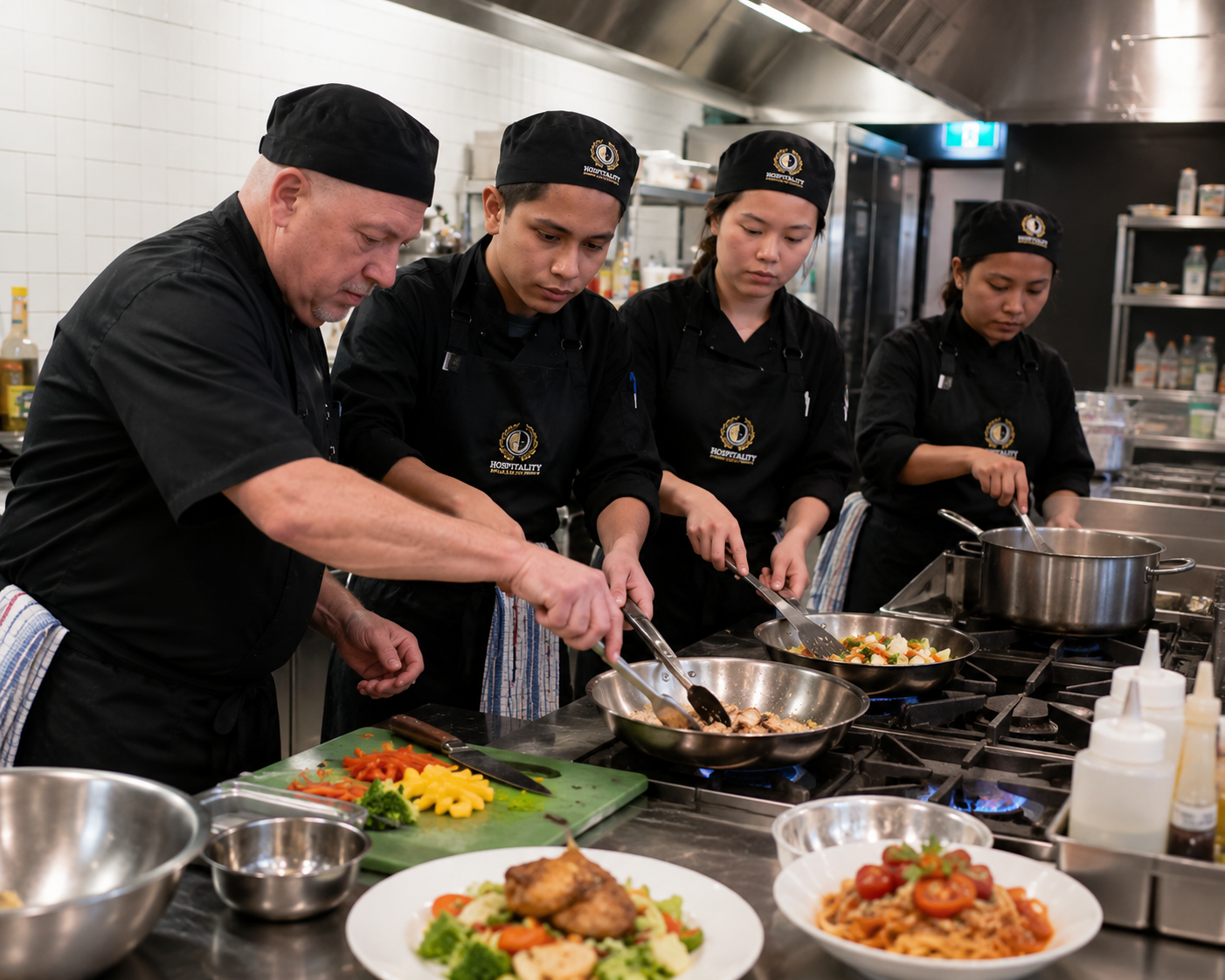
Qualification Description
This qualification is designed for cooks who possess a wide range of well-developed cookery skills and a solid understanding of kitchen operations. It equips individuals to prepare food and menu items using discretion and judgment, often working with some independence and under limited supervision, while adhering to established plans, policies, and procedures.
The skills covered by this qualification must be applied in accordance with Commonwealth and State or Territory legislation, Australian standards, and industry codes of practice.
At the time of publication, no specific occupational licensing, certification, or legislative requirements apply to this qualification.
Location of Delivery
QLD – Gold Coast
Level 1, 9 Bay Street, SOUTHPORT, Queensland 4215
NSW – Sydney
Level 6 16-18 Wentworth St, PARRAMATTA, New South Wales 2150
Mode of Delivery (Duration and Mode of Delivery)
This qualification will be delivered over 60 weeks, including 48 weeks of training and assessment and 12 weeks of holidays.
You will be required to attend face-to-face 20 hours per week of training and assessment in a classroom.
Note that supplementary classes will be scheduled, and attendance required, should additional classes be necessary to allow for sessions missed because of public holidays or other interruptions, and/or for students who require further training, reassessment, or additional support.
Sample Weekly Timetable:
- Monday: 8:00 AM – 5:00 PM (including 1-hour break)
- Tuesday: 8:00 AM – 5:00 PM (including 1-hour break)
- Wednesday: 8:00 AM – 12:15 PM (including 15-minute break)
Career Outcomes
Completing this qualification contributes to recognition as a trade cook and provides a pathway to employment in various settings, including restaurants, hotels, clubs, pubs, cafes, and coffee shops.
Employment Schemes
This qualification prepares a person to select, adapt and transfer skills to a new environment and to provide technical advice and some leadership in resolution of specific problems. This would be applied across a range of roles in a variety of contexts with some complexity in the extent and choice of options available.
(Source: AQF Implementation Handbook 2007)
Learning Pathways
You may enrol in the following qualification/s upon the completion of this program to further enhance your knowledge and skills:
Certificate IV in Kitchen Management
Diploma of Hospitality Management
Units of Competency
25 units must be completed
- 20 core units
- 5 elective units, consisting of:
- 3 units from Group A or Group B
- 2 units from Group A, Group B or Group C
All electives chosen must contribute to a valid, industry-supported vocational outcome.
Note: Units marked with an * have one or more prerequisites. Refer to individual unit details for prerequisites.
| CODE | UNIT NAME | TYPE |
|---|---|---|
| SITXFSA005 | Use hygienic practices for food safety | Core |
| SITXFSA006 | Participate in safe food handling practices | Core |
| SITHCCC023* | Use food preparation equipment | Core |
| SITHCCC027* | Prepare dishes using basic methods of cookery | Core |
| SITXWHS005 | Participate in safe work practices | Core |
| SITHCCC028* | Prepare appetisers and salads | Core |
| SITHCCC029* | Prepare stocks, sauces and soups | Core |
| SITHCCC030* | Prepare vegetable, fruit, eggs and farinaceous dishes | Core |
| SITHCCC031* | Prepare vegetarian and vegan dishes | Core |
| SITHCCC035* | Prepare poultry dishes | Core |
| SITHCCC036* | Prepare meat dishes | Core |
| SITHCCC037* | Prepare seafood dishes | Core |
| SITHCCC041* | Produce cakes, pastries and breads | Core |
| SITHCCC042* | Prepare food to meet special dietary requirements | Core |
| SITHKOP009* | Clean kitchen premises and equipment | Core |
| SITHKOP010 | Plan and cost recipes | Core |
| SITHPAT016* | Produce desserts | Core |
| SITXHRM007 | Coach others in job skills | Core |
| SITXINV006* | Receive, store and maintain stock | Core |
| SITHCCC043* | Work effectively as a cook | Core |
| SITHCCC026* | Package prepared foodstuffs | Elective – A |
| SITHCCC032* | Produce cook-chill and cook-freeze foods | Elective – A |
| SITHCCC033* | Re-thermalise chilled and frozen foods | Elective – A |
| HLTAID011 | Provide First Aid | Elective – C |
| SITXINV007 | Purchase goods | Elective – C |
Entry Requirements (Overseas Students)
Although the training package does not stipulate any entry requirements for
this training product, HTA has the following entry requirements in place for
international students:
- Be at least 18 years of age.
- Participate in a course entry interview (pre-enrolment review) to determine
suitability of the course and additional support needs. - Undertake HTA’s ACSF Level 5 LLND assessment.
- Must have access to and bring their own portable device (laptop or tablet
with keyboard) to class with an up-to-date Microsoft Office suite (Word,
PowerPoint, Outlook, Excel). - Must provide evidence of English Language proficiency as stated under the
English Language Requirements below.
English Language Requirements
Prospective students who are not exempt from providing English Test results
must have taken any of the following test types and achieved the minimum score
within the last three (3) years.
Prospective students exempt from providing evidence of an English Test must
provide evidence of English language proficiency. HTA uses the Dynamic
Placement Test to assess proficiency where other forms of evidence do not
satisfy the provider.
| Test Type | Score or Level | Minimum Score and at least 10 Weeks ELICOS | Minimum Score and at least 20 Weeks ELICOS |
|---|---|---|---|
| International English Language Testing System (IELTS) | 6.0 | 5.5 | 5.0 |
| TOEFL Internet-Based Test | 64 | 46 | 35 |
| Cambridge English: Advanced (CAE) | 169 | 162 | 154 |
| Pearson Test of English Academic (PTE Academic) | 50 | 42 | 36 |
| Occupational English Test (OET) | B for each test component | B for each test component | B for each test component |
* On 26 July 2023, TOEFL iBT stopped offering English language tests for
Australian visa purposes. Only scores from a test taken on or before 25 July
2023 are accepted.</em >
** From 12 February 2024, only results from the paper-based Cambridge C1
Advanced test will be accepted for Australian visa and migration purposes.
Scores from both test modes taken before this date remain valid within the
specified period.</em >
English Language Requirement Exemptions
You are not required to provide evidence of English language proficiency if
one of the following applies:
- You are a citizen and hold a passport from the UK, USA, Canada, New Zealand,
or the Republic of Ireland. - You are an applicant who is a Foreign Affairs, Defence sponsored student, or
a Secondary Exchange student (AASES). - You are enrolled in a principal course of study that is a registered school
course, a standalone ELICOS course, a course delivered in a language other
than English, or a registered postgraduate research course. - You have completed at least 5 years of study in English in one or more of
the following countries: Australia, UK, USA, Canada, New Zealand, South
Africa, or the Republic of Ireland. - In the two (2) years before applying for enrolment, you completed, in
Australia and in English, either a Senior Secondary Certificate of Education
or a qualification at Certificate IV level or higher from the Australian
Qualifications Framework, while holding a student visa.
Note: You may be required to provide evidence of an English
test score with your visa application if you hold a British National Overseas
(BNO) passport.
English Language Test Evidence Exemption
You do not need to provide evidence of an English test score with your visa
application if one of the following applies:
- You are a citizen and hold a passport from the UK, USA, Canada, New Zealand,
or the Republic of Ireland. - You are a Foreign Affairs, Defence sponsored student, or a Secondary
Exchange student (AASES). - You are enrolled in a registered school course, standalone ELICOS,
non-English course, or postgraduate research course. - You have completed at least 5 years of study in English in Australia, UK,
USA, Canada, New Zealand, South Africa, or the Republic of Ireland. - Within the last 2 years, you completed a Senior Secondary Certificate of
Education or Certificate IV (or higher) qualification in English in
Australia while on a student visa.
If you are exempt from providing an English test score, you will still be
required to provide evidence of the exemption and may need to complete an
English Placement Test conducted by HTA.
Conditions of Entry
For international students, it is a condition of entry that upon acceptance,
you must provide evidence of having an Australian Student Visa (subclass 500).
You are required to discuss your capabilities and any concerns during the
course entry interview. Information about the LLN test and course entry
interview is provided in the Student Support section of our Student Handbook.
Entry Requirements (Domestic Students)
Although the training package does not stipulate any entry requirements for this training product.
HTA has the following entry requirements in place for international students:
- Be at least 18 years of age.
- Participate in a course entry interview (pre-enrolment review) to determine suitability of the course and additional support needs.
- Undertake HTA’s ACSF Level 5 LLN assessment.
- Must have access to and bring their own portable device (laptop or iPad and other tablets with a keyboard) to class with up-to-date Microsoft Office suite (Word, PPT, Outlook, Excel).
Student Support Services
HTA has a range of Student Support Services available for you. Please refer to our student handbook for details on available Student Support Services.
Assessment Method
Assessment is based on the principles of competency-based training. Performance of learners is assessed on their ability to perform the task(s) to industry standards. To ensure the principles of validity are upheld, a variety of learning styles and a range of assessment strategies are used.
Assessment for each unit of competence will be through a combination of classroom-based and work placement tasks. Classroom-based assessment includes but is not limited to:
- Classroom exercises
- Assignments
- Practical demonstrations
- Group activities
- Projects
- Verbal and/or written questions
Students are advised well in advance of assessment activities and may put forward for consideration any special needs they may have. The assessment criterion is documented in all modules and workbooks. Dates of assessment are provided on the first day of class along with a timetable. Students may be assessed by a combination of continuous assessment and examinations. Continuous assessment may be based on competencies and marks, or a combination of both.
Recognition of Prior Learning (RPL) and Credit Transfer (CT)
HTA offers all students the opportunity to apply for Recognition of Prior Learning (RPL).
Please refer to our Accepting and Providing Credit Policy and Procedures.
Assessment Appeals
Students can make an appeal against any assessment decision by following the Complaints and Appeals Policy outlined in the Student Handbook and our website.
All appeals and complaints will be dealt with following the Complaints and Appeals Procedure.
Uniform
All Hospitality students will be given (charges included in fees) one full set of chef’s uniform through a designated supplier. The chef’s uniform consists of:
- Chef’s jacket
- Trousers
- Apron
- Chef’s hat
- Protective footwear
- Full set of knives for all practical classes (to be locked at all times)
All students must wear a full set of chef’s uniform when they attend training in the commercial kitchen.
Dress code while attending theory class at campus
There is a dress code for all hospitality students. Students are required to wear an HTA shirt or blouse and any colour trousers or skirt while attending class. Flat black non-slip covered shoes must always be worn.
All learners are required to dress in accordance with the Cookery Students Dress Code while attending workplace training.
Accreditation
This qualification is nationally recognised under the Australian Qualification Framework (AQF) at Certificate III/ IV level. As a registered training organisation, qualifications issued by Australian Professional Skills Institute are nationally recognised. If all units of competency are not achieved in this qualification, a Statement of Attainment will be issued for the units that have been deemed competent.